
Why Do We Do What We Do?
Is there truly such thing as a selfless act?

“We are not only creatures of reason, we are also creatures of the need to be noticed.”
— Alain de Botton
Why do we do the things we do? Not the big-ticket reasons like survival or money, but the quieter, smaller choices that make us feel seen.
The guy in a detention centre who wants to run the pool comp or the sweepstake’s. The one who organises the events. The person people go to for advice, or a laugh, or a fix. The one who proofreads assignments, plans workouts, or just knows how to make others feel better about themselves.
The person who likes to create in order to achieve.
We all want a part to play. It’s just a case of figuring out which part is for you.
In prison and detention, you see it magnified. When everything familiar is stripped away, people start to reinvent themselves. The old boss becomes the cleaner. The quiet one becomes the peacekeeper. The tough guy becomes the artist. Everyone is searching for a role, a reason, a small patch of purpose that tells them they still matter.
Out there, the world’s no different… just louder. There’s more noise to hide behind, more distractions to drown out the search for meaning. But when you strip all that back, it’s the same thing underneath. Everyone wants to belong. Everyone wants to be recognised for something.
The deeper I go into counselling and psychology, the clearer it becomes that most of our behaviour is shaped by reinforcement, especially positive reinforcement. Behavioural psychologist B.F. Skinner described it as the foundation of learning: we repeat behaviours that bring rewards. The human brain releases dopamine when we’re praised or acknowledged, and that chemical reaction reinforces the habit. It’s why the “good boy” or “well done” from childhood lingers in adult life, morphing into likes, promotions, applause, or admiration.
I’m surrounded by case studies every day (including my own), and I find it fascinating to watch how people strive to be noticed for something. Anything.
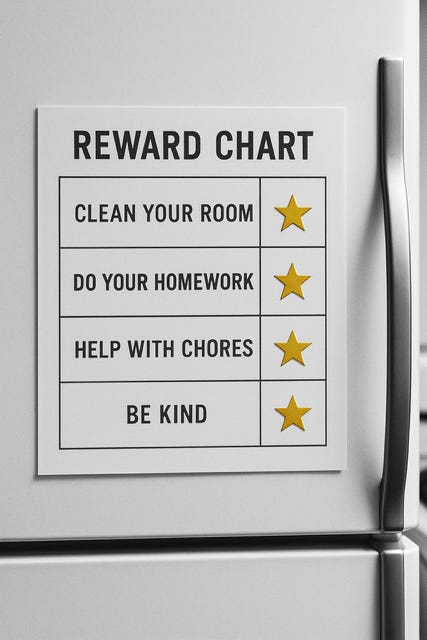
From childhood we’re trained to associate “doing good” with getting praise. Share your toys. Help your brother. Set the table. Be kind. Each time, you’re met with a smile, a thank you, a pat on the back. That’s positive reinforcement at work, operant conditioning shaping our identity. So we learn early on: do good, feel good.
And it sticks with us.
As adults, we tell ourselves we’ve outgrown that need, but we haven’t. We just dress it up differently. Look at charity work. I’ve done plenty of fundraisers in my time, and I genuinely wanted to help worthy causes. But if I’m honest (and I ask you to be the same), the recognition felt good too. It’s not that I did it for the praise, but it added something. It reinforced the effort.
Even psychiatrist Alfred Adler, one of the founding figures of psychology, argued that the deepest human drive isn’t pleasure or power, but significance, the feeling that we matter and belong.
Ponder this for a moment.
Maybe… there’s no such thing as a completely selfless act. Even when we give, we receive something… a sense of connection, belonging, or worth.
It’s part of being human.
When I wrote my book, built my website, or launched the Unshackled app, the first thing I wanted to do was show the people I love. The same goes for my workshops. I love seeing my family proud of me.
That feeling hasn’t faded with age. I’ll be forty-four next month, and I still get the same little kick I did as a kid when someone says, “That was really excellent what you did.”
And you know what? I don’t think there’s anything wrong with that.
We all crave meaning. If we didn’t, that’s likely a bigger issue to deal with. We all want to feel that what we do makes a difference… and that someone notices the effort. Maybe that’s not ego. Maybe that’s connection.
So maybe the goal isn’t to stop caring about recognition, but to understand why it matters to us. Because at the heart of it, purpose and belonging are intertwined. We find purpose through the roles we play for others… and belonging through the meaning those roles give back to us.
It’s perfectly okay to want to share proud moments. It’s okay to feel good when someone notices. We’ve all got to find our purpose and meaning, in whatever way makes us feel alive.
What have you done lately that makes you proud?
Stay Unshackled, my friends.
Stephen
Disclaimer
As most of you know, I’m currently in Immigration Detention. Any mentoring or support I offer… whether to my fellow detainees or to people beyond these walls… is given freely, with no charge attached. I don’t accept payment for mentoring, whilst I am in custody. The real “reward” is seeing the effort the lads put into becoming the best versions of themselves. My commitment is simple: that anyone I work with here leaves stronger, wiser, and better than they came in. That’s the whole point of rehabilitation, isn’t it?
Now, a quick note for clarity. While voluntary donations (mostly from family and friends) sometimes come in through this writing platform to help me get by, they’re never expected, never required, and never a condition for access. Everything I share… words, support, encouragement… is available to everyone, with or without a donation.
There's a very good movement to shift calling kids "attention-seeking" as a derogatory label, to "connection-seeking" which more accurately describes how we're all wired to crave social approval. Attention for kids is not just nice; it's crucial. They can literally die without it. So kids seeking attention are adapting to harsh reality and following biological imperatives that are life-saving. Connection is, of course, a more healthy and deep result if it's on offer. So often, for kids, it is not.
I love how you broke this down. I tend to bristle at interpretations of human behaviour that lean into just different forms of conditioning, as I do think that may be a little too simplistic (and maybe that's the fault of the hearers). So many kids with autism have been deeply, deeply harmed by attempts to "condition" them into normalcy. I know that's not what you're talking about, but it comes up in my head. And at the same time, the little dopamine hits I get when I get likes for my work here are not nothing. Of course I want attention, AND connection, and money, and all the things. You're right, even the most charitable acts are usually self-serving at some level, and we all kinda know it.
Anyway, it's an essay worth reading and I think it's also always good to check our egos and occasionally wonder why we do the things we do...really.
So thanks, and God bless where you are. I can't imagine.