
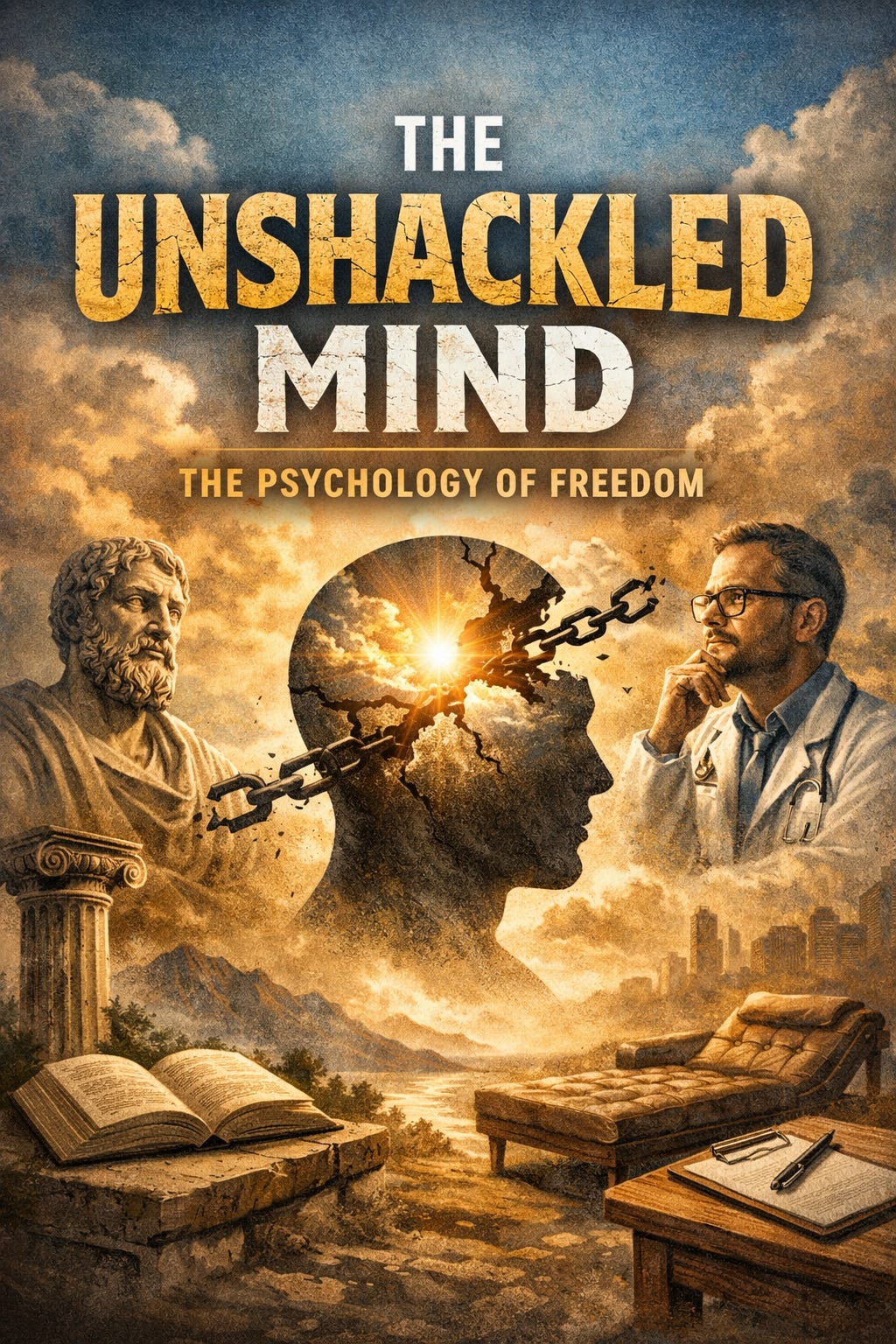
The Unshackled Mind
The Psychology of Freedom: Where Psychology meets Philosophy

Most people hear the word philosophy and immediately switch off.
Their eyes glaze over like they’ve just been handed a 700-page instruction manual for assembling a wardrobe that only comes with two screws and a vague sense of optimism.
Philosophy, for many, sounds like something that belongs in dusty universities, discussed by people who have the time to debate the meaning of existence over oat milk lattes.
But the philosophies that actually survived thousands of years weren’t designed for lecture halls.
They were designed for life.
Real life. The messy, unpredictable, occasionally ridiculous version we all find ourselves navigating. The kind where plans collapse, people behave in ways that make absolutely no sense, and your carefully thought-out strategy gets ambushed by reality before breakfast.
The ancient Stoics understood this better than most. Thinkers like Epictetus and Marcus Aurelius weren’t sitting around trying to sound clever. They were trying to answer a far more practical question.
How do you keep your head when life insists on acting like a lunatic?
The Stoics arrived at a deceptively simple idea.
Divide life into two categories.
What you can control.
And what you cannot.
Your effort. Your values. Your actions. Your choices. That’s your department.
Other people’s opinions. Random misfortune. The past. The future. The weather. Airline delays. Government bureaucracy. All firmly outside your job description.
The problem is that most of us spend a shocking amount of emotional energy trying to control the second category.
We replay conversations in our heads like we’re preparing evidence for a courtroom drama that will never take place.
We worry about things that might happen six months from now, even though the brain has an absolutely terrible track record at predicting the future.
And we try to manage the thoughts and reactions of other people, which is a bit like trying to herd cats while blindfolded.
Meanwhile the one thing we actually do have control over quietly gets neglected.
Our response.
What’s interesting is that modern psychology eventually arrived at the exact same conclusion.
In the 1950s, psychiatrist Albert Ellis began developing a form of therapy based on a simple but slightly confronting idea. People are not disturbed by events themselves, but by the beliefs they hold about those events.
A few years later, psychiatrist Aaron Beck developed Cognitive Behavioural Therapy, now one of the most widely used psychological treatments in the world. CBT teaches that our thoughts influence our emotions and behaviours. Change the interpretation and you can change the experience.
Sound familiar?
Two thousand years earlier, Epictetus had already written something remarkably similar.
“It is not things themselves that disturb us, but our judgments about them.”
Different century.
Different language.
Same inconvenient truth about the human mind.
Perhaps the most powerful real-world example of this comes from psychiatrist Viktor Frankl.
Frankl was imprisoned in Nazi concentration camps during the Second World War. In circumstances that most of us can barely begin to comprehend, he noticed something remarkable about human resilience.
Even when every external freedom had been stripped away, something still remained.
The freedom to choose one’s attitude.
Frankl later wrote words that echo the Stoics almost perfectly.
“Everything can be taken from a man but one thing: the last of the human freedoms — to choose one’s attitude in any given set of circumstances.”
When you step back and look at it, the overlap between ancient philosophy and modern psychology becomes hard to ignore.
Both arrive at the same slightly uncomfortable realisation.
Life is never going to become fully controllable.
You can plan it. Prepare for it. Pray for it if you’re that way inclined.
But at some point life will still walk in, knock over the furniture, and make itself comfortable.
The real question is how you respond when it does.
Since studying counselling, this connection between ancient Stoic thinking and modern psychology has become impossible for me to ignore. Many of the therapeutic approaches used today are essentially structured ways of helping people rediscover something the Stoics figured out a very long time ago.
Your thoughts shape your experience of reality.
Change the way you interpret something and you change your emotional relationship to it.
Now that doesn’t mean pretending everything is grand when it clearly isn’t. That sort of toxic positivity is about as useful as bringing a water pistol to a house fire.
What it does mean is recognising that while we may not control the storm, we do get a say in how we stand in the rain.
This is where the idea of an Unshackled mind begins.
An Unshackled mind is not a mind that lives without difficulty.
It is a mind that refuses to be imprisoned by the illusion that life must unfold exactly as planned.
It understands that uncertainty is inevitable.
That setbacks will happen.
That people will occasionally behave in ways that make you question whether common sense has quietly left the building.
But it also recognises something equally important.
Your response remains yours.
Always.
In counselling you often see how powerful this shift can be. Someone arrives convinced their circumstances have completely defined them. Their anxiety, their past mistakes, their current situation.
It feels final.
But when people begin to understand how much influence they still have over their thinking, something changes.
They regain a sense of agency.
They stop fighting battles that cannot be won and begin focusing on the ones that can.
They realise resilience is not the absence of hardship.
It is the ability to meet hardship without completely losing the run of yourself.
The Stoics understood this long before therapy rooms existed.
They believed a good life rested on four simple virtues.
Courage.
Temperance.
Justice.
Wisdom.
Not exactly glamorous virtues, but incredibly useful ones when life inevitably throws a spanner into your carefully organised plans.
None of this makes life easy.
But it does make life navigable.
And perhaps that is the real meaning of freedom.
Freedom is not the absence of obstacles. If that were the case, none of us would ever qualify.
Freedom is maintaining sovereignty over your own mind.
Refusing to let external chaos dictate your inner world.
Accepting what you cannot change while taking responsibility for the choices that remain.
It doesn’t remove the storms.
But it does teach you how to walk through them without completely losing your bearings.
And that, in many ways, is what living an Unshackled life is all about.
Not waiting for the world to become predictable.
But developing the mental freedom to face whatever it decides to throw at you.
Preferably with a bit of humour along the way.
Stay Unshackled, My Friends.
Stephen