
"Loungevity"
A life healthy enough to enjoy. Enjoyable enough to be healthy.

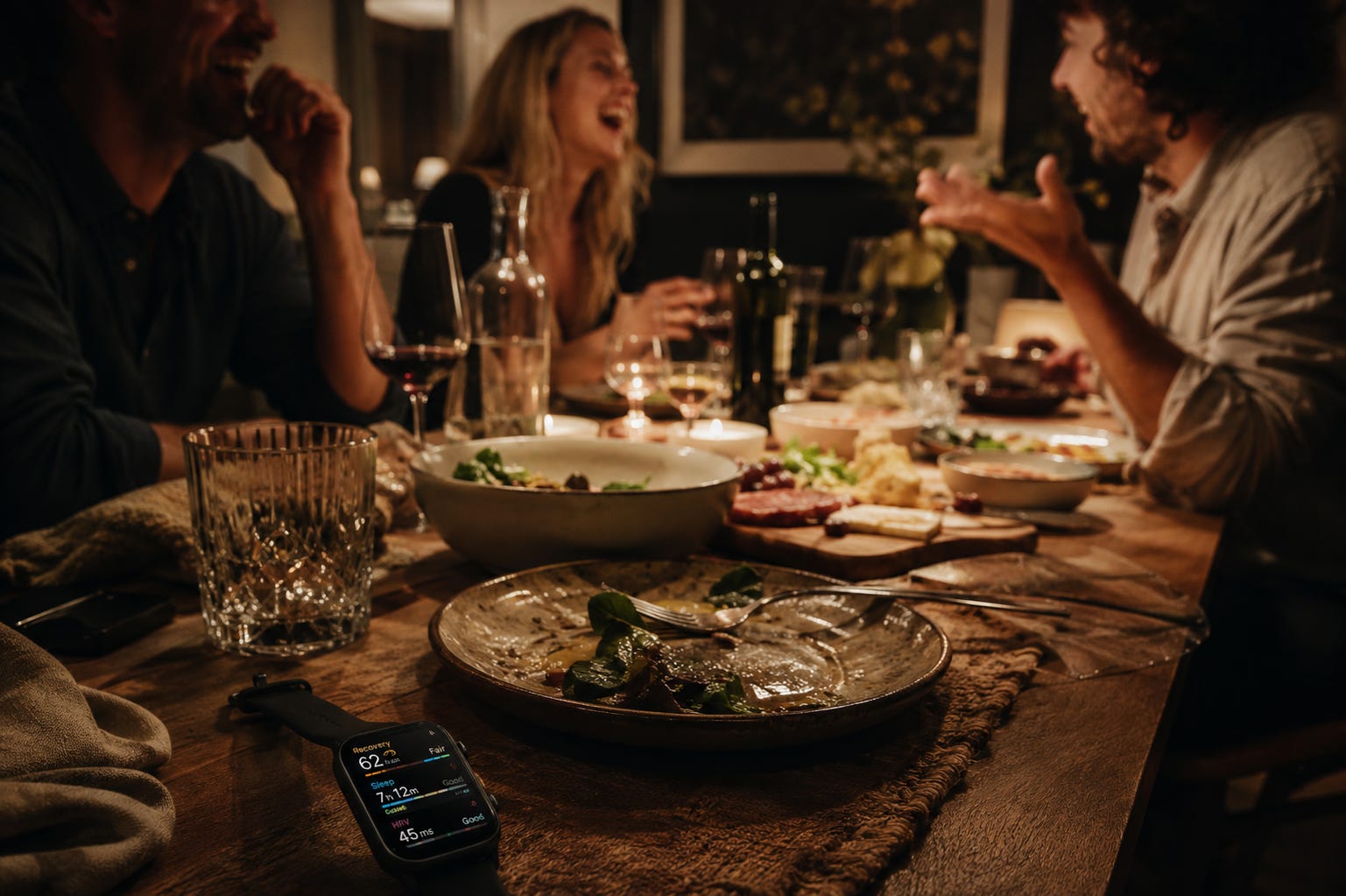
We started trying to extend life. Somewhere along the way, we stopped living it.
I use a tracking app. Bevel, in my case.
It measures sleep, strain, recovery, calories, macros… the full suite. And for a while, I’ll be honest, there was something satisfying about it. Numbers don’t lie. A good score feels like proof you did something right. A bad one feels like a problem you can solve.
But after a while, something shifted.
The measuring itself started to feel exhausting. Not the underlying habits, the sleep, the movement, the eating well. Those are good things and I still believe in them. What got exhausting was the constant audit running underneath everything. I felt like I was living in the app, constantly inputting data. Was I optimising, or am I just living, and is there even a difference anymore?
That last question is the one that stuck with me.
There’s a story happening in culture right now that I think is worth paying attention to.
For the best part of a decade, we’ve been sold a particular vision of what a good life looks like. Wake at five. Track everything. Optimise the body like a piece of software that simply needs the right inputs. Sleep score, recovery score, HRV, macros, supplements, the full architecture of relentless self-improvement.
Bryan Johnson has become the most extreme public face of this. A tech entrepreneur running what he calls a project to not die, an enormous daily regimen of supplements, biomarker tracking, and a team of doctors managing his body like a piece of long-term infrastructure. Whatever you think of the project itself, it’s the purest expression of where this culture has been heading. Optimise everything. Measure everything. Extend everything.
And recently, something has started to crack in the culture’s relationship with that whole idea.
People are getting tired.
Not tired of looking after themselves. Tired of the audit. Tired of the quiet sense of failure that creeps in when the recovery score comes back amber and the whole day feels somehow tainted before it’s even started.
Here’s the thing nobody quite says out loud.
You can hit every macro and still miss the moment that actually mattered… the dinner, the phone call, the conversation that didn’t fit neatly into the schedule because connection rarely does.
You can have the perfect morning routine and spend the entire year feeling like you’re failing, because the metrics kept telling you that you were, even while the actual texture of your life was fine. Good, even. Just not measurable in the way the app wanted it to be.
I think about this a lot in here, where time and the body take on a strange new significance. You’d think a place like this would make tracking feel more important, not less. Control over something, anything, when so much else is out of your hands.
But I’ve found the opposite is true.
The more I measured, the further I got from actually noticing. There was a disconnect drift.
There’s a psychological term for part of what’s happening here. It’s called the quantification trap… the tendency to assume that if something can be measured, the measurement is the thing that matters. The number becomes the goal. The lived experience underneath it becomes almost incidental.
Marcus Aurelius never had a sleep score. He had a notebook and a mind he was trying to keep honest. The Stoics were obsessed with self-examination, but the examination was always in service of character, not metrics. Did I act with integrity today. Did I meet the moment well. Not… did I hit eighty-five on recovery.
Those are very different questions, even though they can look superficially similar from the outside. Both involve attention. Both involve discipline. But one points you toward your actual life, and the other points you toward a dashboard about your life.
I want to be clear about something, because I don’t want this to read as an argument against health altogether.
Eat well. Train. Log your calories and macros if that genuinely helps you… there’s nothing wrong with the tools themselves. The problem was never the data. The problem is what happens when the data starts running the show instead of supporting it.
I caught a Colin Cowherd segment recently that put this better than I’ve managed to so far, particularly from a sports analyst I rarely agree with. He was talking about longevity… the obsession with extending life… and he flipped it. What he was really arguing for was something he called “loungevity”. Not living longer for its own sake. Living in a way that’s actually enjoyable along the way.
He finished with a line that struck.
A life healthy enough to enjoy, and enjoyable enough to be healthy.
That’s the whole argument, in twelve words. Health in service of a life worth living… not a life rearranged entirely in service of health.
I’m not telling you to throw away the band or delete the app. I still wear mine.
What I’m saying is that somewhere in the last decade, a lot of us.. me included… started treating the dashboard as the destination. We got so focused on extending our lives that we quietly stopped living the one we already had. You can optimise yourself into a longer life and still spend most of it managing metrics instead of being present for the people and moments that the metrics were supposedly all in service of.
The point was never to live longer for its own sake.
The point was to have more of an actual life to live.
So here’s the practical version of all this, for anyone who recognises themselves in it.
Keep the habits that genuinely serve you. Sleep matters. Movement matters. What you put in your body matters. None of that is in question.
But notice the moment the measuring becomes the point. Notice when you’ve cancelled something that mattered because of a number on a screen. Notice when a good day got quietly ruined by an amber score that had nothing to do with how the day actually went.
That’s the moment to put the dashboard down and ask the older, simpler question instead.
Remember why you want to stick around longer. If it’s to be with your loved ones for longer, then maybe be with them right now. That’s what is in your control.
Not how do I optimise this life.
How do I actually live it.
A life healthy enough to enjoy. Enjoyable enough to be healthy.
Stay Unshackled, My Friends.
Stephen